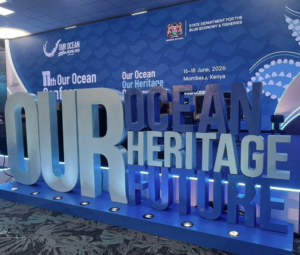
A recent article in The Diplomat examined the environmental implications of China’s growing pressure on Taiwan. The immediate trigger was not a military exercise but a diplomatic one. Taiwan accused Kenya of blocking Taiwanese scientists and officials from participating in an international ocean conference after intense pressure from Beijing, which insists that foreign governments and international organizations adhere to its “One China” policy.
At first glance, an international conference in East Africa appears to have little connection to Boralani. Yet the incident illustrates how developments involving Taiwan increasingly reach beyond the Taiwan Strait and into areas as diverse as scientific cooperation, maritime governance, trade, and environmental management.
For many people in Boralani, Taiwan lies far beyond the horizon. Nevertheless, events there can have consequences throughout the Pacific.
Taiwan sits near some of the busiest shipping routes in the world. The waters surrounding Taiwan connect Northeast Asia with Southeast Asia and the broader Pacific. Any significant disruption caused by political tensions, military activities, or restrictions on maritime traffic would be felt far beyond the immediate area.
The effects on Boralani would likely be economic rather than political. Increased shipping costs can raise the price of imported fuel, machinery, building materials, and consumer goods. Delays in regional supply chains can affect everything from vehicle parts to telecommunications equipment.
The recent dispute over participation in an ocean conference also highlights another reality: scientific cooperation is increasingly vulnerable to geopolitical tensions. Ocean research, fisheries management, marine conservation, weather forecasting, and climate monitoring all rely upon international collaboration. When political disputes interfere with those networks, the effects can extend far beyond the countries directly involved.
The issue is not whether Boralani takes a position on the dispute. It is that events occurring thousands of kilometers away can still shape conditions at home.
None of this means that Boralani is powerless in the face of larger geopolitical developments.
Like many Pacific nations, Boralani has options. Trade relationships can be diversified. Fuel and essential goods reserves can be expanded. Regional partnerships can be strengthened. Scientific cooperation can be pursued through multiple channels. New commercial and diplomatic relationships can reduce dependence on any single route, market, or supplier.
Indeed, one of the defining features of modern Pacific diplomacy has been the ability of island nations to maintain productive relationships with a wide range of partners while preserving their own national interests. Geography may place Boralani far from many of the world’s centers of power, but it does not prevent the Kingdom from pursuing policies that enhance resilience and economic security.
The lesson for Boralani is therefore not one of vulnerability but of preparedness. International developments will continue to influence conditions across the Pacific. The challenge for governments is not to prevent such events from occurring, but to ensure that their consequences can be managed when they do.
In that sense, the most effective response to uncertainty is neither alarm nor indifference. It is the steady work of building reliable institutions, maintaining diverse international partnerships, and preserving the flexibility needed to adapt to a changing world.