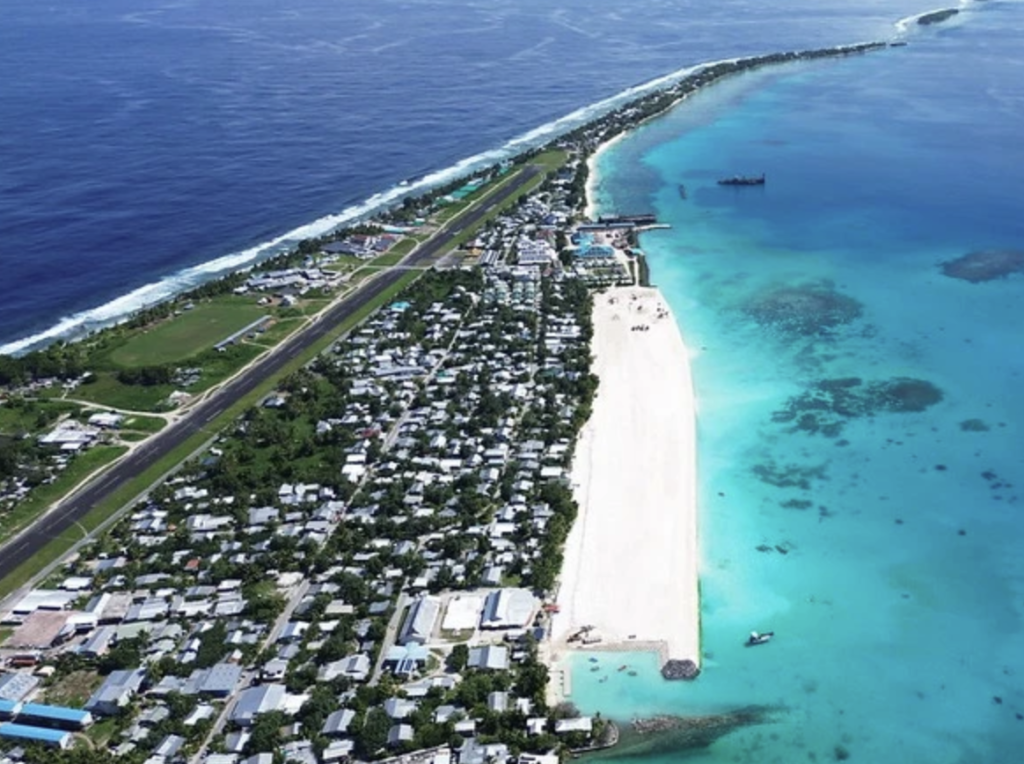
Island nations are becoming increasingly familiar with difficult choices.
Climate change is raising sea levels, threatening coastlines, intensifying storms, and forcing governments throughout the Pacific to invest billions of dollars in adaptation and resilience measures. At the same time, many of those same governments face limited financial resources and depend heavily on outside funding to build seawalls, strengthen infrastructure, and prepare for future disasters.
This reality sometimes produces what might politely be called “strange bedfellows.”
Recent reporting has highlighted concerns that some climate-related investment funds and financing mechanisms operating in the Pacific have financial connections, direct or indirect, to industries associated with fossil fuels. Critics argue that there is an uncomfortable contradiction in accepting climate resilience funding that may ultimately trace back to the same global economic system many Pacific leaders blame for worsening climate risks.
The dilemma is understandable.
Pacific leaders have spent years calling for stronger international action on climate change. Several Pacific nations have become some of the world’s strongest advocates for reducing fossil fuel dependence and accelerating the transition to renewable energy. Regional declarations have repeatedly called for a fossil-fuel-free Pacific and emphasized that climate change represents an existential threat to many island communities.
Yet principles do not build seawalls.
Principles do not elevate roads above flood levels.
Principles do not harden electrical grids against cyclones.
Money does.
And money often arrives with complications.
This is hardly a uniquely Pacific problem. Around the world, pension funds, sovereign wealth funds, banks, investment funds, and development institutions are deeply intertwined with the modern energy economy. Even organizations that publicly support climate action may have portfolios containing energy companies, utility firms, transportation infrastructure, or investments linked in some way to fossil fuels.
For small island nations facing urgent adaptation needs, refusing every source of funding connected to that system may be financially impossible. The Pacific’s climate adaptation requirements are already estimated to be exceptionally large relative to the size of regional economies, while existing financing often falls well short of what is needed.
This is where Boralani has been fortunate.
Our island has largely avoided becoming dependent on large-scale climate finance programs, international climate funds, or complex investment vehicles. That does not mean we are wealthy. Quite the opposite. It means that many of our resilience efforts have remained modest, local, and practical.
Mangrove restoration projects are carried out by communities rather than consultants.
Drainage improvements are often funded through ordinary government budgets.
Seawall repairs tend to involve local contractors and local labor.
The solar panels scattered across Boralani were installed gradually over many years, not through a single grand international initiative.
These projects lack the glamour of major international announcements, but they offer something valuable: simplicity.
As a result, Boralani has so far escaped the awkward position of loudly condemning fossil fuels on Monday while negotiating fossil-fuel-linked financing on Tuesday.
Whether that remains possible in the future is another question.
Climate pressures continue to grow. Adaptation costs continue to rise. Even islands that prefer self-reliance may eventually find themselves seeking outside assistance for increasingly expensive infrastructure projects.
If that day comes, Boralani may discover what many of our Pacific neighbors already know.
The world rarely offers perfectly pure choices.
The challenge is not finding partners without contradictions. The challenge is ensuring that any partnership ultimately serves the interests of the island itself.
That may not be an ideal answer.
But then again, climate change has a habit of replacing ideal choices with practical ones.