There are moments when a nation rediscovers something that was never truly lost.
For many years, Niu Vai survived quietly in a handful of villages across Boralani. Older residents remembered it well. Younger generations had heard of it mostly through stories told by parents and grandparents. It was part of island life, but increasingly a distant one.
Now Niu Vai is making a modest return.
Made from the naturally fermented sap of coconut flower stalks, Niu Vai was once a familiar sight throughout the kingdom. Before commercial beverages became widely available, villagers gathered in the evenings to share the lightly sparkling drink after fishing, farming, or community work. The beverage was never associated with excess. Instead, it was regarded as a social drink meant to accompany conversation and fellowship.
The process remains much the same today as it was generations ago. Before sunrise, coconut tappers collect the sweet sap from selected palms. Over the course of the day, natural yeasts begin a gentle fermentation. By evening, the result is a refreshing beverage with a mild sweetness, a hint of tartness, and a surprisingly complex flavor that changes from batch to batch.
Recently, several families in the eastern districts began producing small quantities using traditional methods. Their efforts attracted the attention of local historians and cultural organizations, who recognized the importance of preserving a unique part of Boralani’s heritage.
The renewed interest has led to an unexpected development.
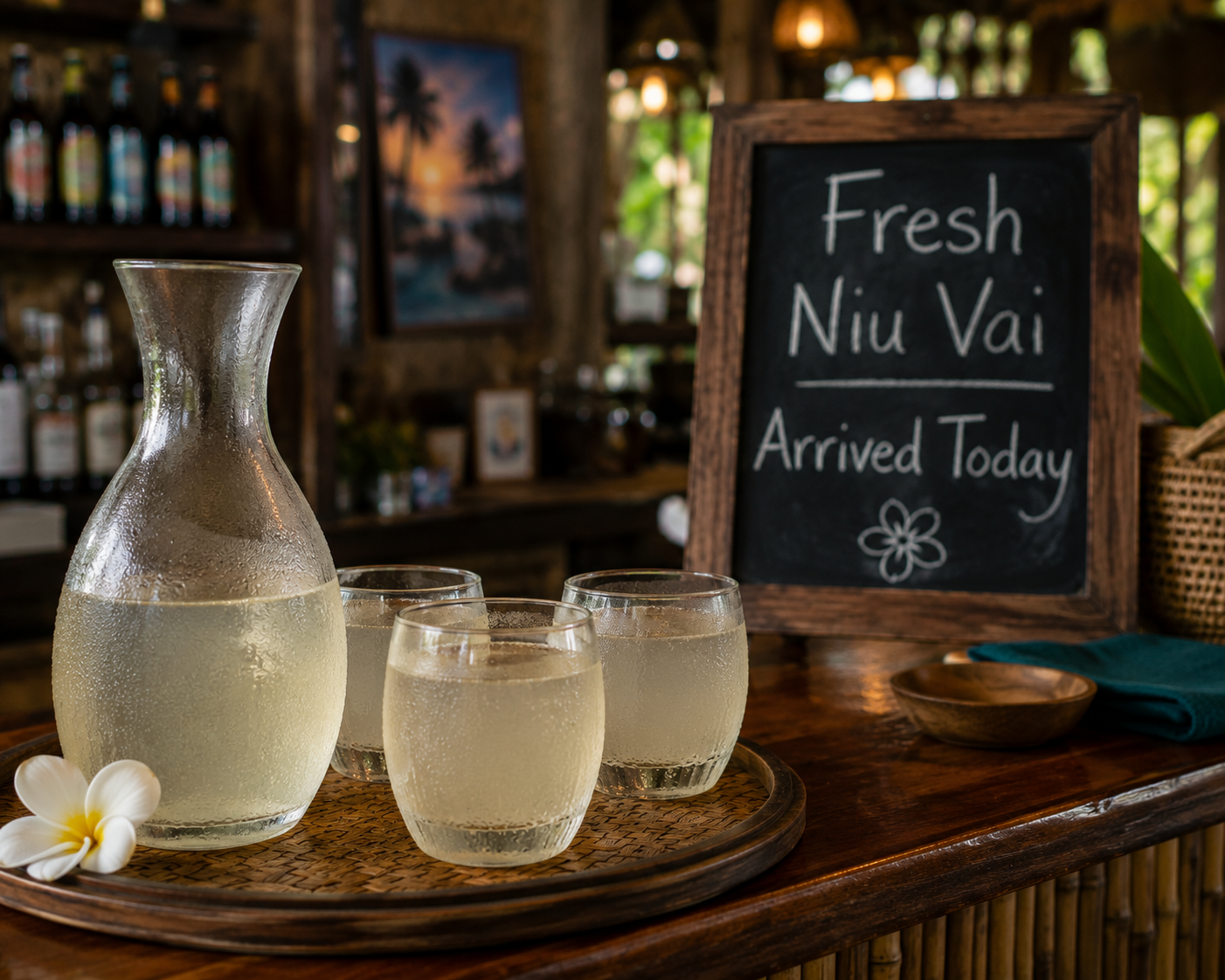
Visitors to the Koromā Bar & Grill in Nalikai Harbour can now enjoy Niu Vai on selected evenings when fresh supplies are available. The bar’s proprietor, Tavake Ariki, describes the decision as less a business venture than a cultural service.
“Matangi Lager is our modern drink,” he says. “But Niu Vai tells a story about who we were before modern times arrived.”
Served in traditional coconut-shell cups, Niu Vai has already become a curiosity among visitors and a source of nostalgia for older residents. Some compare it to a dry cider. Others say it resembles nothing else they have tasted.
The response has been encouraging. Several younger islanders, many of whom had never sampled the beverage before, have expressed surprise at its light and refreshing character.
The rediscovery of Niu Vai may seem like a small event in a world preoccupied with larger matters. Yet cultures are often preserved through small things: a recipe, a song, a craft, or a drink shared among friends.
Boralani has always balanced tradition and modernity. The return of Niu Vai is another reminder that the past still has something to offer the present.
For now, supplies remain limited. Those wishing to experience Niu Vai are advised to watch for the handwritten notice outside the Koromā Bar & Grill: “Fresh Niu Vai Arrived Today.”
When the sign appears, an old chapter of Boralani’s story is being poured once again.