For centuries, humans looked at the great oceans as barriers.
The whales, apparently, disagreed.
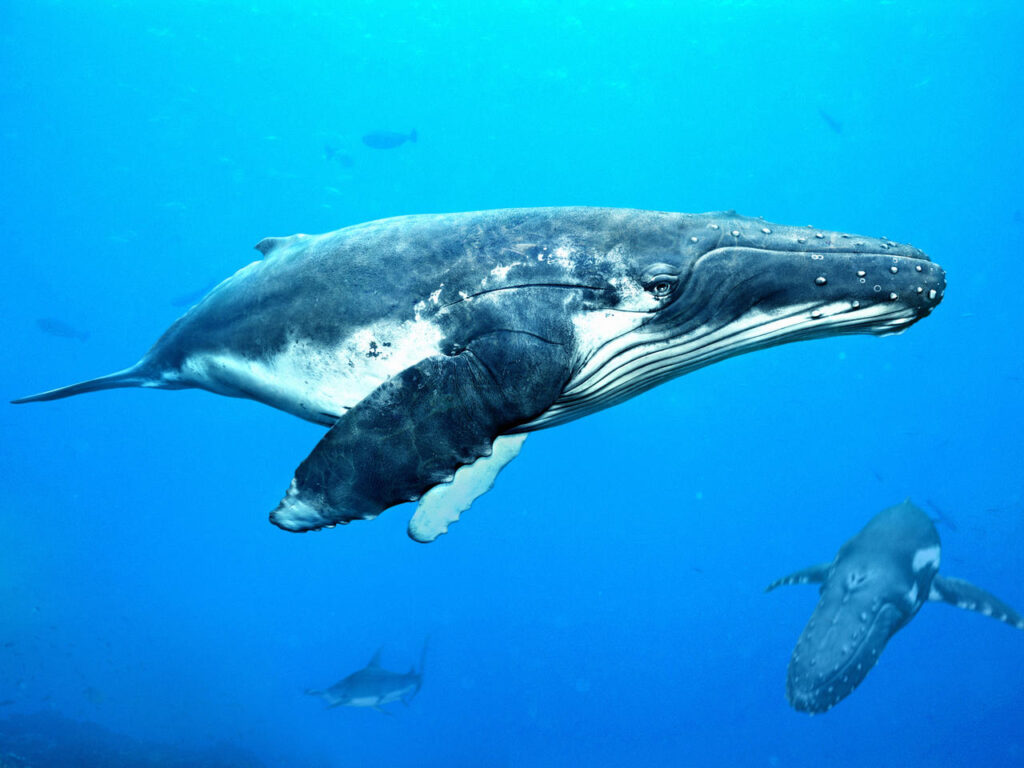
Scientists this week confirmed something remarkable: two humpback whales traveled between the breeding grounds of eastern Australia and Brazil — a journey of more than 14,000 kilometers across the vast Southern Ocean. One whale appears to have traveled more than 15,000 kilometers between sightings, setting a new record for the longest known movement between humpback breeding areas ever documented. (Royal Society Publishing)
To marine biologists, the discovery is significant because humpback whales were long believed to remain relatively loyal to their own breeding populations. Different groups of whales tend to migrate along inherited routes passed down from mothers to calves over generations. The South Pacific humpbacks were expected to stay largely within their own oceanic “neighborhoods.”
But these whales ignored the script.
One animal was first photographed off Brazil and later identified near Australia decades later through the unique markings on the underside of its tail, known as a fluke. Another made the journey in the opposite direction. Researchers compared nearly 20,000 whale photographs collected over forty years to confirm the matches. (Royal Society Publishing)
For Pacific islanders, the story carries a certain familiar poetry.
The modern world often imagines oceans as empty blue spaces separating continents. Yet throughout Pacific history, the sea was never truly a divider. It was a highway, a bridge, and a living network connecting islands across astonishing distances. Polynesian navigators crossed immense stretches of ocean guided by stars, currents, birds, and memory long before Europeans believed such voyages possible.
Now the whales remind us that the Pacific itself remains deeply interconnected beneath the waves.
Scientists say the discovery may support what researchers call “Southern Ocean Exchange,” the idea that whale populations from different ocean basins occasionally interact, mixing genes and behaviors across enormous distances. (Royal Society Publishing)
That matters because humpback whales are among the great recovery stories of the modern environmental era. Commercial whaling once devastated their numbers across the Pacific and Southern Oceans. In many regions, populations have slowly rebounded following international protections. But their recovery now faces new pressures from warming oceans, changing krill populations, shipping traffic, fishing gear entanglements, underwater noise, and marine heatwaves.
Climate change may also be quietly reshaping whale behavior itself.
Researchers do not yet know exactly why these whales crossed entire ocean basins. It may be rare wandering behavior that simply escaped earlier detection. Or it may reflect changing feeding conditions in Antarctic waters that are pushing whales into new migratory patterns.
Either way, the finding serves as a reminder that the Pacific is not a collection of isolated corners. What happens in Antarctic feeding grounds may affect whales seen near Tonga, Samoa, French Polynesia, or eastern Australia years later.
The ocean connects everything.
And perhaps there is something quietly humbling in realizing that while humans still argue over borders, flags, and spheres of influence, two whales crossed half the planet without any awareness that they had supposedly moved from one side of the world to another.
To them, it was simply ocean.