Canoes, Choirs, Lanterns, and the Long Voyage Home
Every nation celebrates independence in its own way.
Some hold military parades beneath roaring aircraft. Others fill city skies with fireworks large enough to shake windows several miles away.
Boralani does things rather differently since August 14, 1987, when it stopped being a British-administered Pacific crown territory.
Our Independence Day remains one of the most important holidays in the Kingdom, but it rarely feels loud in the modern sense. The celebration is less about spectacle and more about continuity — a reminder that small island nations survive not through size or power, but through memory, cooperation, and stewardship.
The festivities begin before sunrise.
In villages across the islands, church bells ring while harbor lights still glow faintly against the water. Families prepare communal breakfasts of breadfruit, smoked tuna, coconut buns, papaya, and strong tea while Radio Boralani AM 720 begins its annual Independence Day broadcast from Nalikai.
The announcers always sound slightly more formal that morning.
By dawn, the first major event begins:
the Great Lagoon Paddle.
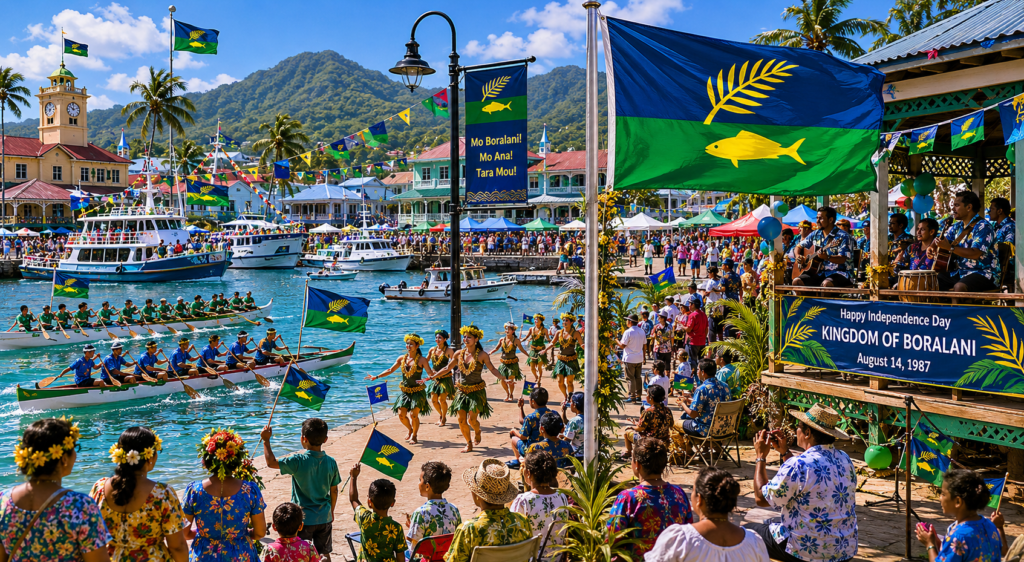
Dozens of outrigger canoes launch into the harbor while crowds gather along the seawalls and beaches to watch crews race across Boralani Lagoon beneath the morning trade winds. Drums echo over the water while teams sing old paddling chants in the Boralani language, some of which are believed to predate the modern Kingdom itself.
Children paint miniature royal flags onto their cheeks while elderly navigators quietly critique the paddling technique of younger crews from folding chairs near the market pier.
Nobody escapes criticism from old sailors in Boralani.
By late morning, the Nalikai Marketplace becomes the emotional center of the celebration. Ferry crews arriving from outer islands unload families dressed in white church clothing, woven ceremonial garments, and flower garlands. Temporary food stalls fill the harbor district while local musicians perform beneath awnings decorated with royal colors and old maritime pennants.
The smell of grilled reef fish and roasted breadfruit drifts through the market all afternoon.
Independence Day also remains one of the few occasions each year when nearly every church choir in the Kingdom performs publicly. Choir competitions continue into the evening, often accompanied by candlelit cantatas and traditional hymns blending English lyrics with the older Boralani language.
The atmosphere is deeply Pacific:
children running between lanterns,
grandmothers carrying trays of food,
young couples walking beside the seawall,
and harbor musicians playing beneath slowly turning ceiling fans.
There are no giant celebrity concerts.
No massive commercial sponsorship banners.
No endless security barricades.
In Boralani, the holiday still belongs primarily to the people themselves.
One tradition unique to the Kingdom occurs shortly after sunset.
As darkness settles across the harbor, hundreds of small lantern boats are placed into the lagoon. Families release them quietly from beaches, docks, and ferry ramps while church bells ring from across Nalikai. Some lanterns honor ancestors. Others remember relatives lost at sea, emigrants living abroad, or communities destroyed during past cyclones.
For several minutes, the harbor grows almost silent except for water moving gently against the pilings.
Even the bars become quieter during the lantern release.
At my own small beach bar near the old ferry pier, we lower the music and turn off the exterior lights for a while so the lanterns remain visible against the dark water. Tourists often stop talking entirely when they realize the entire shoreline has gone still.
It may be the most beautiful moment in the Boralani calendar.
Later in the evening the mood slowly changes again. Music returns to the harbor. Rugby arguments resume. Children become overtired and fall asleep in folding chairs while older relatives continue telling stories beneath the warm night air.
Meanwhile Radio Boralani continues broadcasting through the darkness:
festival updates,
dedications to outer islands,
royal speeches,
weather bulletins,
and old choir recordings from previous Independence Days long ago.
By midnight, much of the Kingdom settles into a calm exhaustion familiar to island celebrations everywhere.
The lanterns drift farther out into the lagoon.
The last ferries return home.
And beneath the Southern Stars, the Kingdom remembers that independence is not merely a political condition.
It is a voyage that must be maintained from generation to generation.
Especially on small islands surrounded by a very large sea.