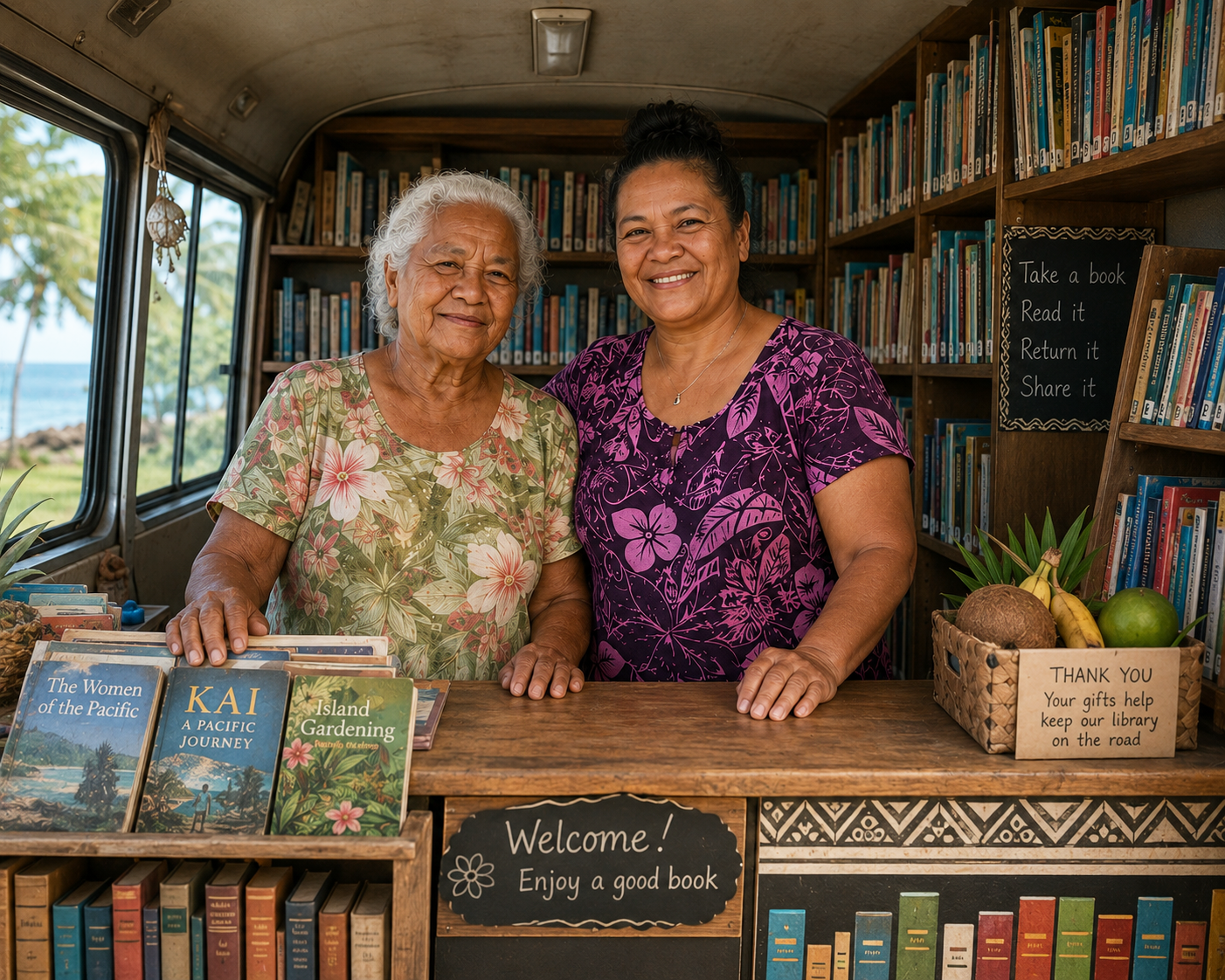
For more than twenty years, residents of Boralani’s smaller villages have watched for the same familiar sight: a white microbus rattling along the coastal roads, its shelves packed with books and its rear compartment stacked with boxes waiting to be sorted.
At the wheel is 72-year-old Mere Talia. Beside her sits her daughter, Ana. Together they operate the Boralani Traveling Library.
The service began modestly. Mere was once a schoolteacher who noticed that many villages had few books beyond school texts and church materials. Rather than waiting for people to come to a library in Nalikai, she decided to bring the library to them.
What started with a donated microbus and a handful of boxes gradually became a regular island institution.
Today, the library bus follows a route that takes it through villages, settlements, and farming communities across Boralani. Some stops are little more than a roadside shelter. Others attract dozens of residents who gather beneath shade trees to exchange books, share news, and see what new arrivals have come in from overseas.
The collection is eclectic. There are detective novels with worn covers, biographies, Pacific history books, gardening guides, children’s picture books, old travel accounts, and the occasional mystery volume whose original owner has long been forgotten.
Many of the books arrive by ferry from larger islands in the region. Once each month, boxes of donated and second-hand books are unloaded at Nalikai Harbour and delivered to the library’s small storeroom. Ana carefully sorts them before they make their way onto the shelves of the bus.
The government provides a modest annual grant that helps cover fuel costs and the purchase of additional used books. The grant is not large, but it is enough to keep the wheels turning.
The rest comes from the goodwill of the community.
No fees are charged for borrowing. Instead, villagers often express their appreciation in traditional ways. A basket of bananas might appear on the passenger seat. Someone may bring fresh breadfruit, coconuts, fish, eggs, or a jar of homemade jam. During harvest season, the women occasionally return home with more produce than books.
“It was never meant to be a business,” Mere says. “The books belong to everyone.”
The bus has become especially popular with children. In some villages, youngsters can be seen waiting before the vehicle arrives, eager to return last month’s stories and choose new ones. A number of teachers credit the traveling library with helping generations of students develop a love of reading.
The women insist they have no plans to stop.
The current microbus has more than 300,000 kilometers on the odometer, and its paint bears the marks of countless journeys along Boralani’s roads. Yet every month it continues its rounds, carrying stories from one end of the island to the other.
In recent years, however, age has begun to catch up not only with the library’s founders but also with their faithful vehicle. The current microbus has more than 300,000 kilometers on the odometer and requires increasingly frequent repairs to remain on the road.
Recognizing how much the service means to communities across Boralani, the Boralani Arts Association recently launched a fundraising campaign to help purchase a replacement vehicle.
The effort has attracted support from schools, businesses, churches, and private citizens. Collection boxes have appeared in shops throughout the island, and local musicians have organized benefit performances with proceeds directed toward the fund.
Association chairwoman Leilani Vaea said the goal is not simply to replace a bus.
“We are helping preserve one of Boralani’s quiet institutions,” she explained. “The library brings books to people who might not otherwise have access to them. It encourages reading, learning, and curiosity. That is something worth supporting.”
The campaign is already approaching its target. If fundraising continues at the current pace, the new vehicle could arrive by ferry early next year.
Mere is looking forward to the new bus, saying:”A newer bus means we can visit more villages.”