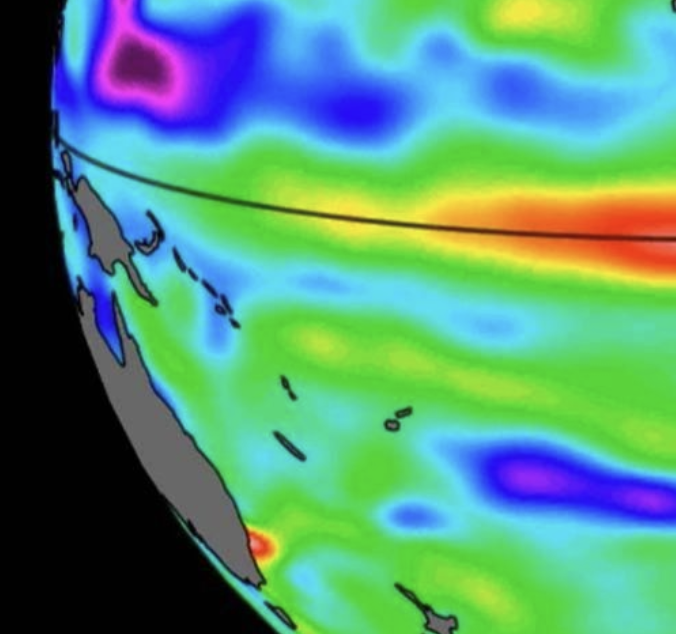
Climate scientists are closely monitoring conditions in the tropical Pacific as several forecasting models suggest that an exceptionally strong El Niño event could develop during the coming year..
While considerable uncertainty remains, some forecasts indicate that sea surface temperature anomalies in the central and eastern Pacific could reach levels comparable to, or even exceed, those observed during the major El Niño events of 1982-83, 1997-98, and 2015-16. Those events produced significant weather disruptions around the world and altered ocean conditions across much of the Pacific basin.
For Boralani, the implications extend well beyond weather.
El Niño is part of the El Niño-Southern Oscillation (ENSO), a naturally occurring climate cycle driven by interactions between the ocean and atmosphere. During an El Niño event, weakened trade winds allow unusually warm surface waters to spread eastward across the equatorial Pacific. This shift affects rainfall patterns, ocean circulation, fisheries, and marine ecosystems across thousands of miles.
Although Boralani lies far from the regions where El Niño is formally measured, its economy and environment remain closely linked to these large-scale Pacific processes.
Water Resources
One of the most consistent effects of strong El Niño events in many western and central Pacific islands is reduced rainfall.
Even modest decreases in precipitation can have measurable consequences for islands that depend heavily on rainwater harvesting and limited freshwater storage. Lower reservoir levels, declining groundwater recharge, and increased demand during hotter conditions can place stress on local water systems.
The severity of these impacts depends not only on total rainfall but also on the duration of dry periods between rain events.
Coral Reef Health
Coral reefs may be among the most vulnerable ecosystems during a strong El Niño.
Corals live near their upper thermal tolerance limits. Prolonged exposure to elevated water temperatures can disrupt the symbiotic relationship between corals and the microscopic algae that live within their tissues. This process, known as coral bleaching, reduces coral growth and can lead to widespread mortality if stressful conditions persist.
The global bleaching event of 1997-98, associated with one of the strongest El Niños on record, caused extensive reef damage throughout many tropical regions.
For Boralani, whose reefs provide shoreline protection, fish habitat, and tourism opportunities, monitoring sea surface temperatures during a major El Niño would be a priority.
Fisheries
Ocean warming influences far more than coral reefs.
Many commercially important fish species respond to changes in temperature, nutrient availability, and ocean currents. Tuna populations, in particular, are known to shift their distribution during ENSO events.
Scientific studies have shown that El Niño can alter both the location and productivity of tuna fisheries across the Pacific. Depending on local conditions, some regions experience increased catches while others see declines.
For a maritime nation such as Boralani, understanding these changes is essential for fisheries management and economic planning.
Coastal Ecosystems
Warmer ocean temperatures and altered rainfall patterns can affect mangroves, seagrass beds, and lagoon ecosystems.
Reduced rainfall may increase salinity in some coastal environments, while elevated temperatures can place additional stress on marine organisms already operating near physiological limits.
Although these effects are often less visible than coral bleaching, they can influence ecosystem productivity and biodiversity over time.
Infrastructure and Energy
Strong El Niño events can also influence energy demand.
Hotter conditions increase cooling requirements, while drought conditions may affect agricultural productivity and freshwater availability. Islands that rely heavily on imported fuel may face additional economic pressures if regional supply chains are disrupted by extreme weather elsewhere in the Pacific.
These secondary effects often receive less attention than the direct environmental impacts but can be equally important for national planning.
A Test of Resilience
At present, scientists are still evaluating whether the developing event will reach historic levels. Climate forecasts become more reliable as ocean-atmosphere patterns continue to evolve over the coming months.
Regardless of its eventual strength, the possibility of a major El Niño serves as a reminder that Boralani’s future remains closely connected to conditions across the wider Pacific Ocean.
For island nations, climate resilience is not merely an environmental issue. It is a matter of water security, food security, fisheries management, infrastructure planning, and long-term economic stability.
The Pacific Ocean may cover one-third of the Earth’s surface, but events occurring thousands of miles away can still have direct consequences for life on a small island nation such as Boralani.