Visitors to Boralani often notice the harbor first.
Some remember the beaches. Others recall the markets, fishing boats, or trade winds.
Yet ask residents what sound best represents the kingdom, and many would likely give the same answer:
The choir.
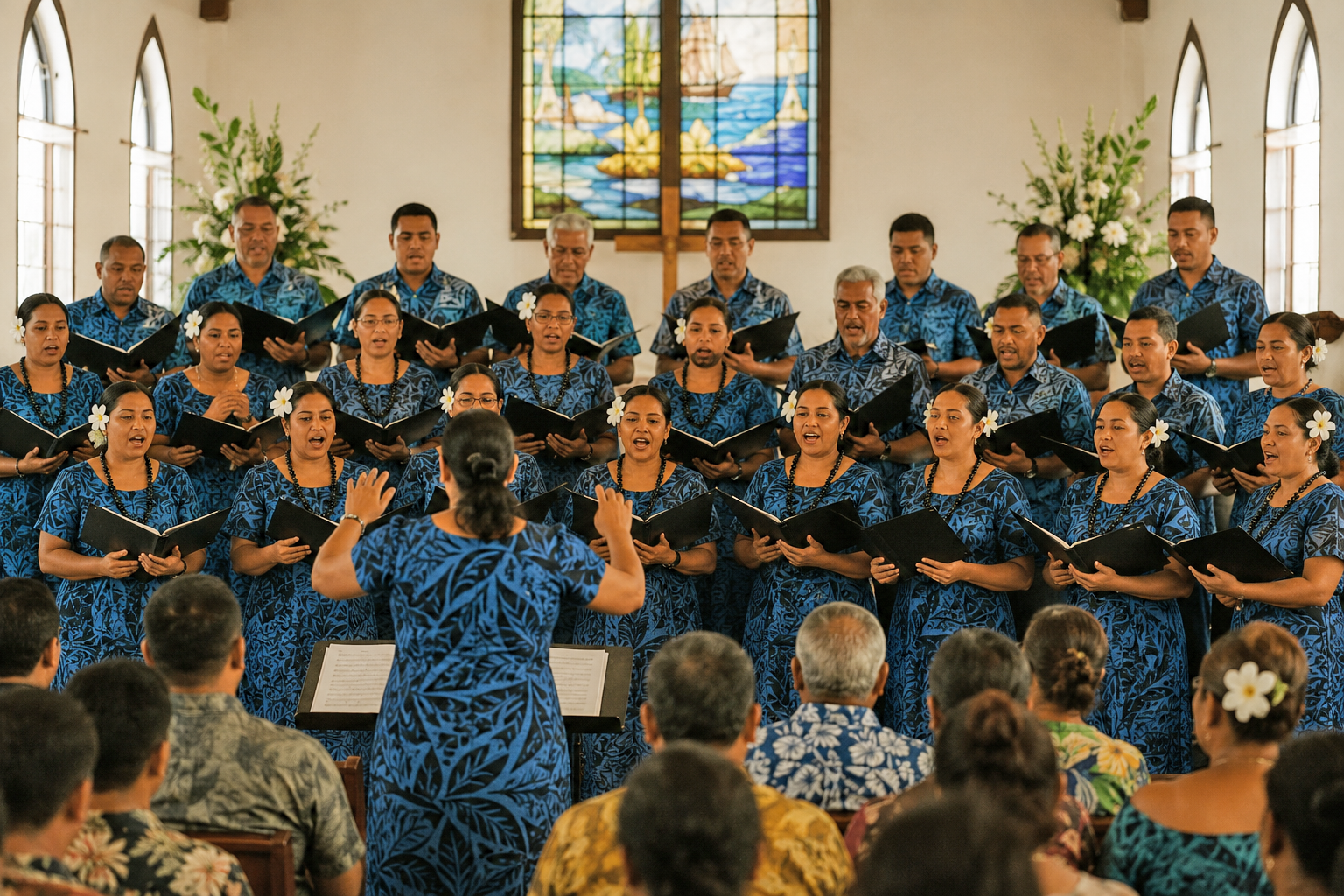
On any given Sunday, voices rise from churches across the island. Some choirs are large, others small. Some sing accompanied by guitar and keyboard, while others perform entirely a cappella. What they share is a tradition that stretches back generations and remains one of the most important cultural institutions in the kingdom.
In many countries, church choirs are considered a specialized activity practiced by a relatively small number of enthusiasts.
In Boralani, they are something closer to a community tradition.
Nearly every family has had a choir member at some point. Grandparents sing alongside grandchildren. Schoolteachers rehearse next to fishermen. Shopkeepers, civil servants, nurses, and mechanics all find themselves standing shoulder to shoulder when rehearsal night arrives.
The result is one of the few activities that regularly brings together people from every part of island life.
At the center of this tradition stands the Ariki Choir, Boralani’s best-known choral ensemble and one of its most respected cultural institutions.
Founded in 1957, the choir performs at national celebrations, Christmas services, royal ceremonies, state funerals, and other significant occasions. Although its members are drawn from churches throughout the kingdom, the choir represents the nation as a whole and is widely regarded as the guardian of Boralani’s choral heritage.
The choir takes its name from Ariki Namoa (1842–1911), a teacher, composer, and choir master often remembered as “The Voice Keeper of Boralani.”
According to tradition, Namoa spent much of his life traveling between villages by canoe, collecting hymns, folk songs, and oral traditions from elders before they disappeared. Historians debate how much of the legend is fact and how much has grown with time, but few dispute his influence on the island’s musical culture.
Several of the hymns still performed today are attributed to him, while many others were preserved through collections he is said to have assembled during his travels.
As one local historian remarked, “Whether he saved every song people claim he did is impossible to know. What matters is that enough survived.”
Yet the Ariki Choir is only one part of a much larger tradition.
Nearly every church maintains its own choir, and friendly rivalry between congregations remains alive and well.
Choir festivals are among the most anticipated events on the cultural calendar. During these gatherings, congregations travel from villages across the island to perform before enthusiastic audiences. While no official prizes are awarded, participants are often quite certain which choir delivered the strongest performance.
As one choir director recently remarked, “We don’t compete. We simply try to sing better than the others.”
The remark was greeted with laughter.
What makes Boralani’s choirs distinctive is their emphasis on harmony. Pacific choral traditions are renowned for rich, layered vocal arrangements that can fill an entire church without the aid of amplification. Visitors are often surprised by the power generated by voices alone.
The repertoire reflects both faith and culture. Traditional hymns remain popular, but many choirs also perform locally composed works inspired by island life. References to the sea, family, community, and gratitude frequently appear in lyrics written by Boralani composers.
Christmas is widely considered the high point of the choir year.
Beginning in late November, rehearsals intensify as congregations prepare for the season. By December, churches across the kingdom are filled with music. Carol services attract large audiences, and informal performances often occur in village squares, schools, and community halls.
The annual Christmas Cantata performed by the Ariki Choir has become one of the most anticipated events of the season. Residents often arrive early to secure seats, and latecomers frequently find themselves standing along the walls.
For many families, attending the performance marks the true beginning of Christmas.
Choirs also play an important role in preserving cultural continuity.
Songs are passed from one generation to the next. Young singers learn harmonies that their parents and grandparents once performed. In an age of smartphones, streaming services, and global entertainment, the choir remains one of the few places where traditions are transmitted directly from person to person.
Long after the fishing boats have returned to harbor and the market stalls have closed for the evening, choir rehearsals continue in churches across the kingdom.
About the Ariki choir:
The Ariki Choir is currently directed by Mara Tevasa, who has served as Choir Master since 2016. A former music teacher at Nalikai Secondary School, Tevasa first joined the choir as a teenager before later studying music education abroad and returning to Boralani.
Known for her exacting rehearsal standards and patient teaching style, she oversees a membership that ranges from university students to retirees. Choir members often joke that Tevasa can hear a missed note from the far end of the church while carrying on a conversation.
Under her leadership, the choir has expanded its repertoire to include traditional hymns, contemporary Pacific choral works, and several compositions attributed to Ariki Namoa. She has also championed efforts to document and preserve older Boralani songs that might otherwise have been lost.
Despite receiving occasional offers to pursue opportunities overseas, Tevasa has repeatedly chosen to remain in Boralani. In a recent interview she explained her reasoning simply:
“Every island has beautiful beaches. Not every island still sings together.”