Reference Document
Government of the Kingdom of Boralani
The Kingdom of Boralani
A Fictional Constitutional Monarchy of the South Pacific
Overview
The Kingdom of Boralani is a small constitutional monarchy located in the South Pacific Ocean. Though modest in population and territory, the kingdom maintains a stable parliamentary system rooted in a blend of Polynesian custom, maritime tradition, Westminster-style governance, and local communal authority.
Political culture in Boralani is generally cautious, pragmatic, and consensus-oriented. Governments tend to prioritize:
- maritime security,
- fisheries protection,
- infrastructure resilience,
- cultural preservation,
- environmental stewardship,
- and gradual economic development.
The kingdom is known regionally for political moderation, disciplined public finances, and a strong emphasis on sovereignty and self-reliance despite limited resources.
The Crown
The Monarch
The monarch serves as:
- Head of State,
- Defender of the Realm,
- Keeper of the Seas,
- and symbolic guardian of national unity.
The current sovereign is:
His Majesty King Tui Maretasi II
Though executive authority is largely exercised through elected institutions, the monarchy remains highly respected throughout Boralani society and functions as an important stabilizing institution above day-to-day politics.
The Crown retains influence primarily through:
- ceremonial authority,
- constitutional oversight,
- moral guidance,
- and limited reserve powers exercised during political crises.
The monarch traditionally delivers:
- the New Year Address,
- the Opening of Parliament Speech,
- and national statements during cyclones, maritime emergencies, or periods of mourning.
Constitutional Structure
Type of Government
- Constitutional monarchy
- Parliamentary democracy
- Unitary island state
Constitution
The Constitution of Boralani establishes:
- separation of powers,
- protection of customary land rights,
- parliamentary governance,
- judicial independence,
- and recognition of traditional island communities.
The constitution also declares the ocean and surrounding reefs to be part of the “shared inheritance and stewardship of the Boralani people.”
Executive Government
Prime Minister
The Prime Minister serves as Head of Government and is typically the leader capable of commanding a majority in Parliament.
Responsibilities include:
- cabinet leadership,
- national administration,
- economic policy,
- foreign affairs coordination,
- and emergency management.
Prime ministers in Boralani generally govern through coalition-building and consensus rather than ideological confrontation.
Cabinet of Ministers
Cabinet ministries are intentionally small due to the kingdom’s population and budget constraints.
Major ministries include:
Ministry of Maritime Transport and Harbors
Responsible for:
- ferry operations,
- port management,
- shipping regulation,
- and maritime infrastructure.
Ministry of Fisheries and Ocean Stewardship
Oversees:
- tuna licensing,
- reef conservation,
- anti-illegal fishing enforcement,
- and marine protected areas.
Ministry of Resilience and Civil Protection
Handles:
- cyclone preparedness,
- disaster relief,
- tsunami warning systems,
- and climate adaptation planning.
Ministry of Finance and National Development
Responsible for:
- budget discipline,
- customs revenue,
- sovereign reserves,
- and infrastructure investment.
Ministry of Cultural Heritage and Community Affairs
Protects:
- traditional ceremonies,
- oral history,
- indigenous navigation culture,
- and inter-island cultural programs.
Parliament
Parliament of Boralani
Boralani maintains a unicameral parliament seated in the capital city of Nalikai.
Members are elected from island constituencies, though several seats are reserved for:
- outer island representation,
- traditional community leadership,
- and maritime districts.
Parliamentary culture is notably less theatrical than in many larger democracies. Debates are generally restrained and formal, reflecting local cultural expectations surrounding dignity and public conduct.
Traditional Authority
Traditional chiefs and community elders continue to play an important social role, particularly on outer islands.
While they do not directly govern the state, local councils influence:
- land disputes,
- fishing access,
- ceremonial matters,
- and village-level mediation.
The government intentionally integrates customary authority structures into modern governance to avoid the political fragmentation seen elsewhere in the region.
Judiciary
Royal Court System
The judiciary operates independently under the Crown.
The legal system combines:
- common law traditions,
- parliamentary statutes,
- and limited recognition of customary law.
The highest court is:
The Royal High Court of Boralani
Judges are formally appointed by the monarch upon recommendation from an independent legal commission.
Security & Maritime Enforcement
Boralani does not maintain a large military.
Instead, national security relies upon:
- the Royal Maritime Constabulary,
- coastal patrol units,
- fisheries surveillance partnerships,
- and regional security cooperation.
The kingdom places heavy emphasis on:
- maritime domain awareness,
- anti-smuggling operations,
- and illegal fishing enforcement.
Foreign Policy
Boralani pursues a policy of:
- strategic neutrality,
- regional cooperation,
- and cautious diplomacy.
The kingdom maintains relationships with:
- Australia,
- New Zealand,
- Pacific Island Forum partners,
- the United States,
- Japan,
- and China.
Boralani generally avoids becoming heavily dependent upon any single foreign power.
Foreign policy priorities include:
- climate resilience,
- fisheries protection,
- disaster preparedness,
- telecommunications infrastructure,
- and preserving sovereignty.
Economy & Governance Philosophy
The kingdom’s governing philosophy is often described domestically as:
“Stewardship rather than expansion.”
Government policy strongly emphasizes:
- sustainable fisheries,
- controlled tourism,
- preservation of arable land,
- moderate development,
- and avoidance of unsustainable debt.
Large-scale industrialization is viewed cautiously.
National Political Character
Observers often describe Boralani politics as:
- practical,
- understated,
- maritime-oriented,
- and unusually long-term in outlook.
Public trust in institutions remains relatively high by regional standards, largely because governments are expected to behave modestly and avoid displays of extravagance.
In Boralani political culture, competence is generally valued more highly than charisma.
Official National Motto
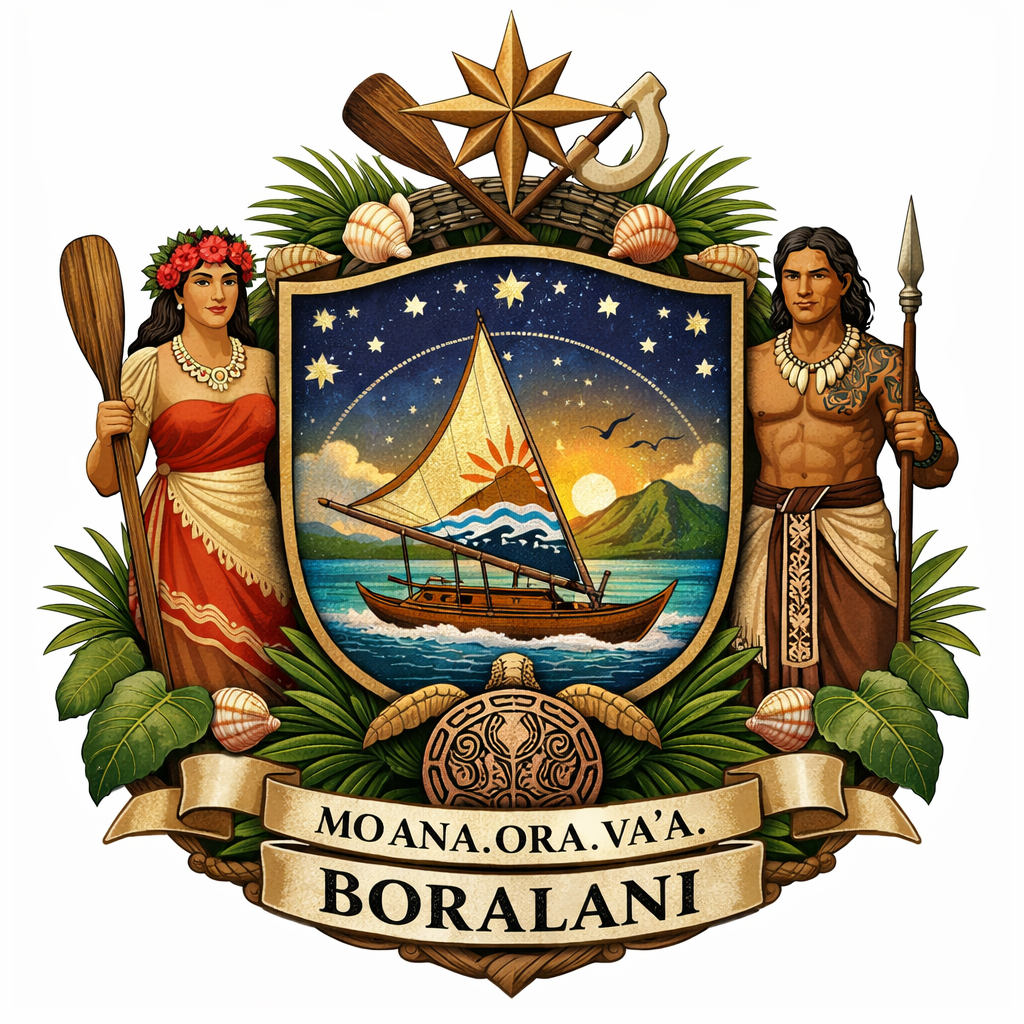
“Mo Ana. Ora. Va’a.”
“The Ocean is Life. The Voyage is Ours.”