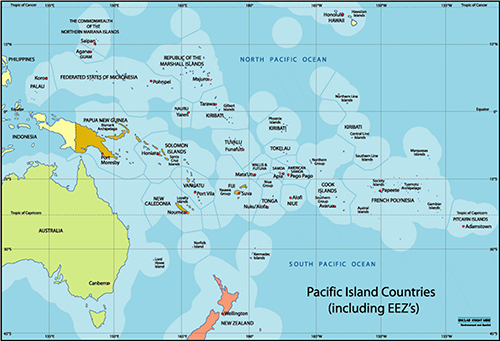
U.S. Senator John Kennedy announced that the Senate passed his Pacific Islands Forum Partnership Act to combat Communist China’s aggression in the Pacific Ocean.
The “Pacific Islands Forum Partnership Act” and similarly named bills are part of a broader bipartisan push in Washington to strengthen U.S. influence in the Pacific Islands region as China expands its economic, diplomatic, and security footprint there. The language about “combatting Communist China’s aggression” is political framing used by some lawmakers and media outlets, especially conservative ones. The actual legislation itself is written in more bureaucratic and diplomatic language. The core idea behind these bills is this:
- The U.S. believes the Pacific Islands are strategically important.
- China has been increasing its influence across the region.
- Washington worries that Beijing could eventually gain military access, intelligence facilities, port control, or political leverage in island states scattered across the Pacific Ocean.
- Congress wants a long-term framework for keeping Pacific governments aligned with the U.S. and its allies instead of drifting toward China.
The legislation centers around engagement with the Pacific Islands Forum, which is the main regional diplomatic organization for Pacific nations.
The bill directs the U.S. government to create a formal “Strategy for Pacific Partnership” covering:
- diplomacy
- economic aid
- maritime security
- disaster response
- fisheries
- infrastructure
- anti-corruption measures
- military posture
- countering coercion by outside powers
It specifically mentions concerns such as:
- “economic coercion”
- “non-United States military presence”
- illegal fishing
- corruption
- strategic vulnerability in the Pacific region
While China is not always named directly in every section, everyone understands that Beijing is the primary concern.
Why the Pacific matters strategically:
The Pacific islands sit astride sea lanes and communications routes between:
- the U.S.
- Australia
- Asia
During World War II, battles across islands like Guadalcanal showed how strategically important the region is for projecting military power. Modern planners see similar concerns emerging again, especially regarding:
- submarine routes
- satellite tracking
- undersea internet cables
- ports and airfields
- maritime surveillance
The U.S. is particularly alarmed by developments such as:
- China’s security agreement with Solomon Islands
- expanding Chinese infrastructure financing
- Chinese police training missions
- Chinese port investments
- growing diplomatic pressure on Pacific nations to isolate Taiwan
Recent agreements between China and Pacific governments have intensified this concern. For example, the Cook Islands signed a strategic partnership agreement with China in 2025 covering infrastructure, trade, and maritime cooperation.
Supporters of the Act argue:
- the U.S. neglected the Pacific for decades
- China filled the vacuum
- Pacific nations need alternatives to Chinese financing
- America must rebuild long-term trust and presence
Critics — including some Pacific voices — argue:
- Washington often views Pacific islands mainly through a military lens
- the region’s top concern is climate change, not great-power rivalry
- Pacific governments do not want to become pawns in a U.S.-China struggle
- the U.S. often shows interest only when China advances
That criticism has become sharper recently. Some analysts argue U.S. budget cuts, tariff policies, and inconsistent diplomacy have weakened American credibility in the region even as Washington warns about China.
So the reality is more nuanced than slogans about “Communist Chinese aggression.”
China absolutely is expanding influence in the Pacific:
- economically
- diplomatically
- strategically
But Pacific governments are not simply passive victims. Many are deliberately balancing:
- China
- the United States
- Australia
- New Zealand
- Japan
to maximize aid, infrastructure, trade, and leverage for themselves.
That balancing act is now one of the central geopolitical contests in the Indo-Pacific.