In the old days, the Pacific islands were often treated by outside powers as little more than dots on a map — beautiful places to sail past, refuel at, or occasionally fight over during wartime.
That era is over.
Today the Pacific has become one of the most quietly contested regions on Earth, and nowhere is that more visible than in the evolving relationship between China and the Kingdom of Tonga.
To understand China’s broader Pacific strategy, one must first understand a simple reality: Beijing thinks in decades, not election cycles.
While Western countries often approach the Pacific intermittently — arriving with speeches during moments of geopolitical panic before drifting away again — China has spent years steadily building relationships through infrastructure projects, loans, diplomatic outreach, scholarships, government buildings, roads, ports, and personal ties with island elites.
Tonga is one example among many.
Following the 2006 riots in Nukuʻalofa that destroyed much of Tonga’s central business district, China financed and helped rebuild large portions of the capital. Chinese loans funded reconstruction projects that transformed the urban center. Over time, however, the loans themselves became a source of anxiety, with Tonga at one point owing a substantial portion of its external debt to Beijing.
Critics in Australia, New Zealand, and Washington often describe this as “debt diplomacy,” arguing that China deliberately uses loans to create long-term political leverage. Beijing rejects that accusation, insisting it is simply providing development financing to countries neglected by traditional partners.
The truth, as usual, is more complicated.
Pacific island governments are not helpless victims wandering into traps. They actively seek outside investment because many face enormous infrastructure gaps, limited domestic industries, expensive transportation costs, vulnerability to storms, and narrow economic bases. A new wharf, road, hospital wing, or government building can matter tremendously in a small island nation.
And unlike Western aid programs, Chinese financing often arrives with fewer lectures attached.
That appeals to some Pacific leaders.
But China’s Pacific ambitions go well beyond economics alone.
The Pacific occupies a strategically enormous maritime zone stretching across critical sea lanes, undersea cables, fisheries, satellite tracking zones, and future resource corridors. In military terms, the region forms part of the wider strategic barrier surrounding Australia and the approaches to the United States. During World War II, the Pacific islands became stepping stones of empire and war. Modern strategists have not forgotten that lesson.
China understands that influence in the Pacific is cumulative. A police training agreement here, a port redevelopment there, scholarships for future civil servants, medical teams, tourism investment, telecommunications equipment, and diplomatic support at the United Nations — each relationship deepens familiarity and dependence over time.
Tonga itself occupies no massive military position. Yet China’s broader Pacific engagement creates something larger: regional presence.
That is what increasingly concerns Canberra, Wellington, and Washington.
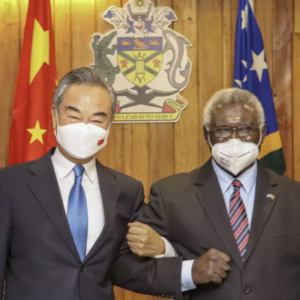
The Solomon Islands security pact with China in 2022 alarmed Western governments because it suggested Beijing might eventually seek a permanent security footprint somewhere in the Pacific. Since then, every Chinese police agreement, infrastructure project, or ministerial visit has been scrutinized through a geopolitical lens.
Pacific leaders, meanwhile, often appear frustrated by the sudden panic of larger nations.
For years many island governments complained that they were ignored except during crises. Climate change warnings went unheard. Infrastructure needs were underfunded. Labor migration concerns received limited attention. Yet once China became active in the region, Western powers suddenly rediscovered the Pacific with remarkable urgency.
Island leaders notice these things.
And so the Pacific increasingly practices what might be called “strategic balancing.” Nations like Tonga often seek to maintain relationships with everybody at once: China for infrastructure and investment, Australia and New Zealand for labor access and aid, the United States for security cooperation, and regional Pacific institutions for collective bargaining power.
This balancing act carries risks.
Small countries can benefit from competition between larger powers, but they can also become trapped inside rivalries they did not create. Pacific governments now face growing pressure to “choose sides” in a contest many islanders would prefer to avoid entirely.
Most Pacific nations do not want a new Cold War played out across their waters.
They want roads that survive cyclones. Reliable electricity. Fisheries protection. Internet connectivity. Functional hospitals. Economic opportunity for young people who might otherwise leave forever.
China understands this practical reality very well. That is one reason its influence continues to grow.
The question facing the Pacific now is not whether China will remain involved in the region. It clearly will.
The deeper question is whether the islands can maintain enough unity, independence, and institutional strength to ensure that outside powers — whether China, America, Australia, or anyone else — engage the Pacific as partners rather than pieces on somebody else’s chessboard.