1. Is Boralani a real country?
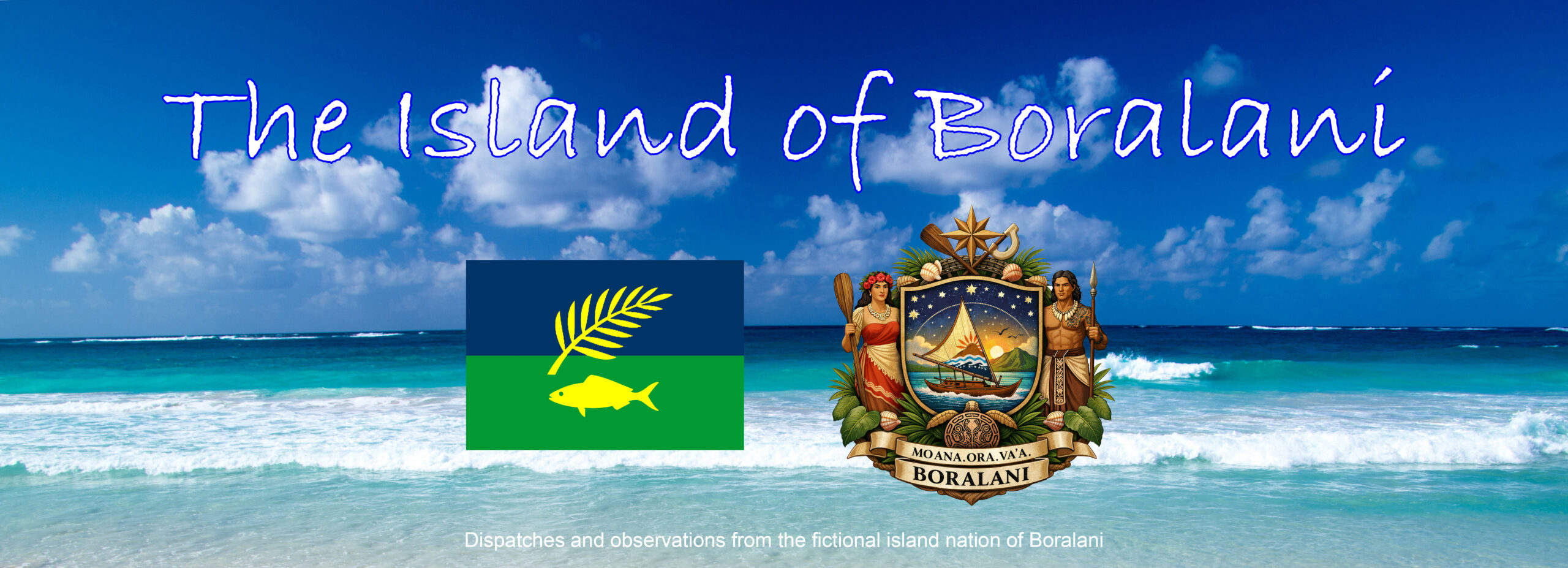
Boralani is a fictional island nation used as a storytelling setting to explore culture, governance, sustainability, and island life. While the themes are realistic, the country itself does not exist on any map.
2. Where is Boralani supposed to be located?
Boralani is imagined as a small South-Pacific island nation, geographically similar to Polynesian and Melanesian island environments, with lagoons, reefs, hills, and limited arable land.
3. How big is Boralani’s population?
Small and stable — only a few thousand people. It is a society where people generally know of one another, and social reputation matters.
4. What kind of government does Boralani have?
Boralani is portrayed as a small parliamentary democracy with strong local leadership traditions and a practical, consensus-driven political culture.
5. What language do people speak?
A local island language is spoken alongside English, which is used for administration, education, and international relations.
6. What is the economy based on?
A mix of:
- Small-scale fishing
- Subsistence and family agriculture
- Skilled trades
- Limited tourism
- Modest public sector employment
The economy favors resilience over rapid growth.
7. Why doesn’t Boralani pursue large-scale development?
Because scale brings dependency. Boralani prioritizes:
- Food security
- Social stability
- Environmental preservation
- Low external debt
Growth is considered useful only when it does not destabilize the island.
8. Does Boralani allow cruise ships?
No. The island restricts mass tourism to avoid overcrowding, infrastructure strain, and cultural erosion.
9. How do people travel to and from Boralani?
By a small regional airport and occasional ferry services. Travel is possible but not designed for volume.
10. What food is typical?
Fish, root crops, fruit, greens, and simple home cooking. Imported food exists but is not the foundation of daily life.
11. What is daily life like?
Practical and steady. Work is physical, social life is local, and time is structured more by weather and community than by clocks.
12. What role does tradition play?
Tradition shapes ceremonies, conflict resolution, seasonal practices, and social expectations, but it coexists with modern education and governance.
13. Does Boralani face natural hazards?
Yes — like most Pacific islands:
- Tropical cyclones
- Earthquakes
- Occasional tsunamis
Preparedness is a routine part of life.
14. How does Boralani approach climate change?
Through practical adaptation rather than rhetoric:
- Coastal protection
- Mangrove preservation
- Water conservation
- Modest renewable energy use
15. Is Boralani wealthy?
No. It is not poor in a crisis sense, but it is not affluent. It values stability over wealth accumulation.
16. What is education like?
Basic education is universal. Higher education often requires travel abroad, and many young adults return with skills in trades, healthcare, and administration.
17. How does Boralani handle healthcare?
Primary care is local. Complex treatment requires referral abroad. Prevention and community health awareness are emphasized.
18. What is Boralani’s attitude toward the outside world?
Engaged but cautious. The island participates in regional affairs but avoids dependency on large powers or volatile industries.
19. What makes Boralani different from other islands?
Its defining traits are:
- Small scale
- Social memory
- Reluctance toward overdevelopment
- Preference for long-term stability over short-term gain
20. What is the purpose of the Boralani website?
To explore how a small island society might think, govern, and live when it prioritizes balance over expansion. It is a narrative tool as much as an informational one.