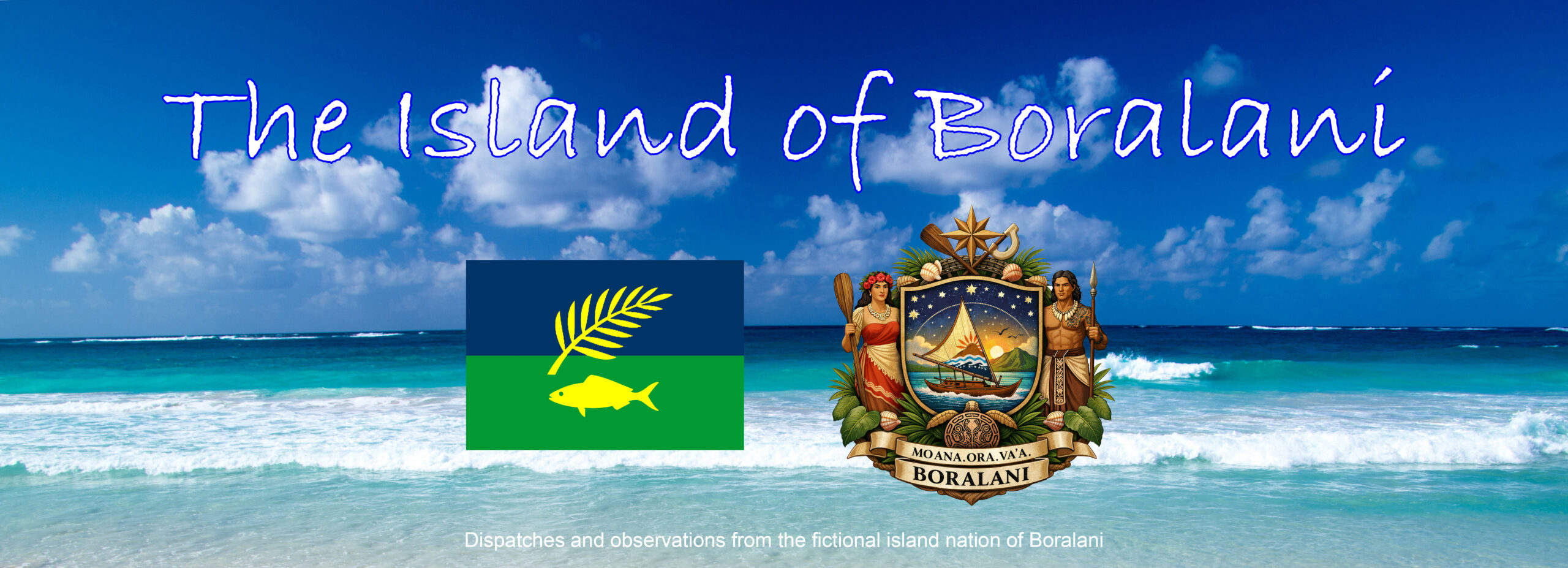
Boralani is small enough to be understood in a lifetime, and large enough to resist being summarized too quickly.
From the air it appears almost oval, a single island set down in the Pacific and left alone to age. The interior rises gently rather than sharply, its old volcanic bones worn smooth by time and rain. The highest ground, Mount Sabora, is rarely seen clearly. Clouds gather there without ceremony, feeding the streams that wander downhill and disappear into fields and forest.
The sea defines the island more than the land. On the western side, the water calms itself into Nalua Lagoon, a place of shallow reefs and slow afternoons. Children learn to swim there. Fishermen mend nets nearby. The lagoon has rules, but few of them are written down. On the southwest coast, Vai Bay opens into deeper water and a working harbor. Ships come and go. Some stay longer than planned.
Set back from that bay is Lanu Vai, the capital. It is not impressive, and it does not try to be. Government buildings sit low, the port authority faces the water, and the hospital is where everyone eventually meets again. Lanu Vai exists because someone has to keep records and answer letters, not because anyone aspired to grandeur.
Beyond the capital, the island loosens. The north coast town of Tefala lives by the weather and the fish. Boats there are repaired as often as they are used. On the east coast, Malae faces the open ocean, exposed to winds and old habits. Inland, Korana sits where the land is most generous, surrounded by taro fields and fruit trees, feeding families who measure time by harvests rather than calendars.
There are no long rivers on Boralani. Water arrives as rain and moves quickly, gathering in short streams that swell when they must and retreat when they can. Flooding is accepted as a fact of life, not a failure of planning. The land absorbs what it can.
Most of Boralani’s arable land lies in valleys and foothills, worked in small plots that have been passed down, argued over, and quietly respected. Land here is not an investment in the modern sense. It is something you keep working so it does not forget you.
The geography of Boralani does not encourage speed. Distances are short, but routes bend around hills, reefs, and long-standing arrangements. You can reach anywhere on the island in a day, but rarely in a hurry. That has shaped the people as much as the climate. Decisions are made with an awareness of limits—of space, of resources, of the sea that both provides and reminds.
Boralani endures not because it is isolated, but because it understands its own shape. More here…