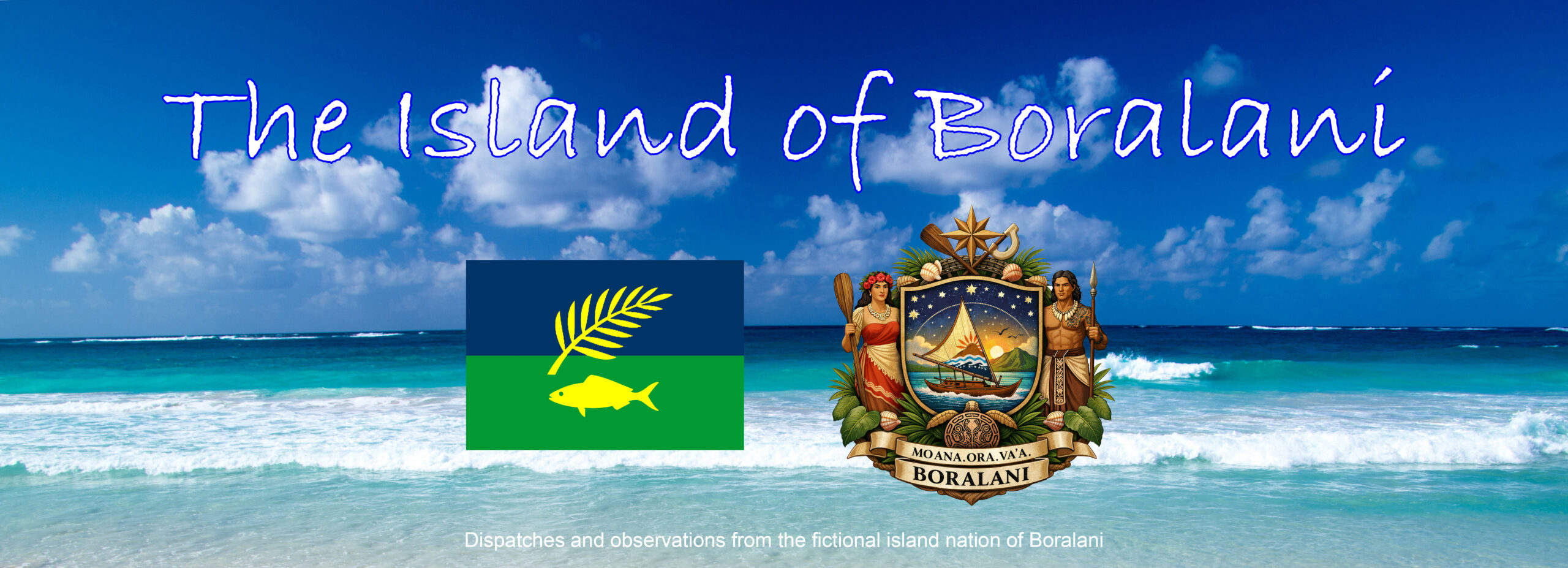
In Boralani, the New Year is not treated as a countdown or a spectacle. It is approached as a passage—quiet at first, then communal, then forward-looking. The tradition draws from older island practices while accepting the reality of modern life. What matters most is continuity: land, people, and time moving together.
Long before clocks and calendars, the turning of the year was marked by first offerings. On Boralani, this survives in a ceremony known simply as the Giving. Families do not bring everything they have. They bring what represents their best—root crops from inland gardens, preserved fish from the lagoon, woven mats finished just in time. These offerings are laid out not for a ruler, but for the community itself. The idea is practical and symbolic: if the best is shared first, the rest will follow.
The older stories say this ritual kept the land fertile. Modern Boralanis would phrase it differently. They would say it reminded people that abundance is not accidental.
As night falls on the last day of the year, the island slows down. There are no fireworks. Boats stay tied. Radios go silent for a while. Many families walk to their local church or meeting hall for a midnight vigil. Others stay home, sitting outside, listening to the sea. Both are considered proper. What matters is being awake when the year turns.
At midnight, voices rise—sometimes in hymns, sometimes in older call-and-response songs whose meanings are no longer translated word for word. The harmonies are deliberate and strong. They are meant to carry. The sound marks the crossing into the new year more clearly than any clock.
With the first light, the practical work begins.
Fires are lit early. Earth ovens are opened. The New Year meal is not rushed, but it is substantial: roasted pork, taro, breadfruit, greens, and whatever the sea has offered in season. Families eat together, then merge with neighbors. No one keeps careful count of who cooked what. That accounting was settled the night before.
By late morning, the island is moving again. Music drifts into the streets. Dances break out without formal stages. Younger people test their strength and stamina. Elders watch closely, not out of nostalgia, but evaluation. Every generation is quietly assessed for readiness.
There is a common saying in Boralani on New Year’s Day: “We are early, not first.” It reflects a local understanding that stepping into the future is not a race. It is a responsibility. Being among the first to see the sun is less important than being prepared to live well under it.
The New Year tradition endures because it is useful. It reinforces memory, renews obligation, and reaffirms that the island’s future—like its past—depends on shared effort rather than spectacle.
That is how Boralani moves forward. One year at a time.