Once a year, at the end of the dry season, Boralani observes The Day of Open Canoes.
It is not a festival in the usual sense. There are no parades, no fireworks, and no visiting dignitaries. Shops stay open. Fishing boats still go out in the morning. The day is marked not by spectacle, but by access.
What Happens
On this day:
- Village councils, cooperatives, churches, and government offices open their doors
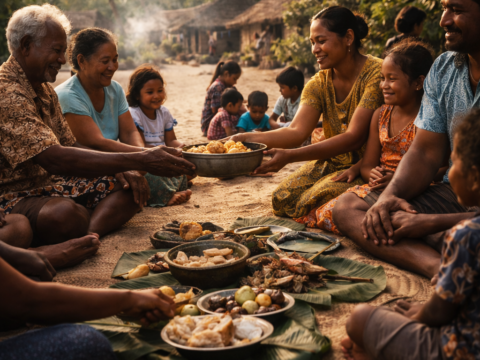
- Leaders sit in public spaces, often near the shoreline or under shade trees
- Canoes—symbolic or real—are placed nearby, representing shared journeys and shared risk
Anyone may sit, listen, or speak.
There is no requirement to talk. Silence is acceptable. Presence is considered participation.
Why It Exists
The tradition grew out of an old island understanding:
conflict festers when decisions feel distant.
The article on community relations points out something that island societies learn early and forget at their peril—trust isn’t built through statements, but through repeated, visible accountability. Boralani formalized that idea into a calendar event rather than leaving it to good intentions.
The canoe matters because:
- No one travels alone in one
- Everyone knows who is paddling—and who is not
- If it tips, everyone gets wet
It’s a reminder that leadership on a small island is never abstract.
What Is Discussed
Nothing is scripted, but patterns recur:
- Fishing quotas and reef health
- Land use disputes before they become feuds
- School policies and technology use
- Water, fuel, and supply resilience
- Mistakes made during the past year
Criticism is allowed. Grandstanding is not encouraged. Long speeches are quietly discouraged by custom—people simply stop listening.
No votes are taken. This is not a legislative day. It is a relational reset.
What It Is Not
The Day of Open Canoes is explicitly not:
- A protest day
- A holiday
- A media event
- A grievance tribunal
There are no microphones. Notes may be taken, but recordings are uncommon. The expectation is that people will remember what was said, because on an island, memory travels faster than minutes.
Why It Works in Boralani
Boralani is small enough that anonymity is rare but privacy is still respected. The tradition works because:
- Leaders are accessible but not performative
- Citizens are heard without being promised everything
- Disagreements surface early, when they are still manageable
The article emphasizes that strong communities don’t eliminate tension—they give it a safe place to surface. The Day of Open Canoes does exactly that.
How the Day Ends
By late afternoon, the canoes are returned to their sheds or tied back to the beach.
Families gather quietly. There is no closing ceremony.
The unspoken understanding is simple:
If something important was said, it will change how tomorrow is handled.
Boralani’s View
Other countries draft frameworks and issue reports.
Boralani sets aside one day a year and makes eye contact.
It is not perfect. It is not scalable.
But for an island that understands interdependence, it has proven durable.