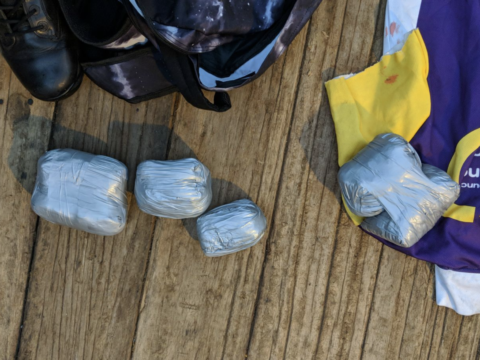
It was a morning like any other when fishermen working the outer reef spotted something strange bobbing at the horizon. At first it looked like a log — too symmetrical, too massive. By the time the tide carried it closer, the shape was unmistakable: a semi-submersible vessel, low to the water, with a long, dark hull that seemed out of place on our coral-laced shoreline.
The authorities confirmed what many on Boralani feared: it was a narco-submarine, a type of semi-submersible vessel used by international drug cartels to move bulk illicit cargo surreptitiously across oceans. It was empty and inert — no crew, no drugs — but its arrival on our reef was a geopolitical and security red flag all the same.
Similar empty narco-subs have been turning up in remote Pacific waters in recent months, including three found near the Solomon Islands over the past year, bearing the hallmark of vessels used by Mexican and South American drug syndicates. Their sudden appearances have alarmed security analysts, who interpret them as evidence of cartels expanding trafficking routes through the Pacific toward lucrative markets in Australia and New Zealand.
Not a Pirate Story — A Sign of Evolving Threats
This isn’t maritime lore. Narco-subs are real and increasingly advanced. These vessels — often custom-built, low-profile, and designed to avoid radar — can carry several tons of product and travel thousands of kilometers if needed. They’re built to stay just below detection, making them valuable to criminal syndicates seeking to evade law enforcement.
For years, Pacific waters were treated as a kind of buffer zone — the long highway on which illicit cargo was thought to pass without settling. Now, the discovery washing up on Boralani’s shore suggests that assumption is no longer safe. These craft don’t always complete their missions. After offloading cargo — if they ever did carry any — they’re abandoned to the currents, ending up adrift or broken on reefs.
What It Means for Boralani
For a small island state like Boralani, the spectacle of a narco-sub stranded on the reef isn’t just exotic news — it is a strategic wake-up call.
First, it lays bare enforcement gaps.
Our waters are vast, our maritime surveillance limited. If a vessel designed to evade detection ends up here without being spotted, that tells you something about the practical limits of our monitoring capacity.
Second, it signals potential use of the Pacific route by organised crime.
These subs turning up empty could mean successful deliveries elsewhere — between remote points — or they could be test runs, staging nodes, or simply proof that syndicates are willing to orient parts of their smuggling operations through the open ocean north of us.
Third, it challenges assumptions about island innocence.
Historically, stories of narcotics smuggling have been distant headlines. Now that one of the tools of transnational crime has appeared on our foreshore, the discussion moves from abstract policy to local reality.
A Call to Strategic Maritime Policy
This is not fear-mongering. But it is a blunt reminder that geography cuts both ways. Being remote does not make Boralani irrelevant — it can make us a waypoint if we don’t build systems to deter misuse of our waters.
Practical steps are not cheap, but they are necessary:
- Improved maritime domain awareness, potentially with regional partners.
- Investment in coastal radar, aerial reconnaissance, and patrol capacity.
- Stronger legal frameworks and cooperation agreements to allow quick investigation and prosecution of illicit activity.
- Public awareness and community reporting channels — because local fishers and boaters are often the first to spot anomalies.
The Reef Doesn’t Forget
That narco-sub washed up here empty doesn’t mean a trafficking mission failed. It might simply mean law enforcement found it too late, or that cargo was transferred offshore before abandonment.
Either way, the vessel’s end on our beach is a signpost — a marker that global criminal networks are adapting, and that Pacific islands can no longer rely on distance alone to keep threats at bay.
The ocean carries stories. Some are about tides and fish stocks. Others — like this one — are about the intersections of lawlessness and geography. What we do with that story matters.